
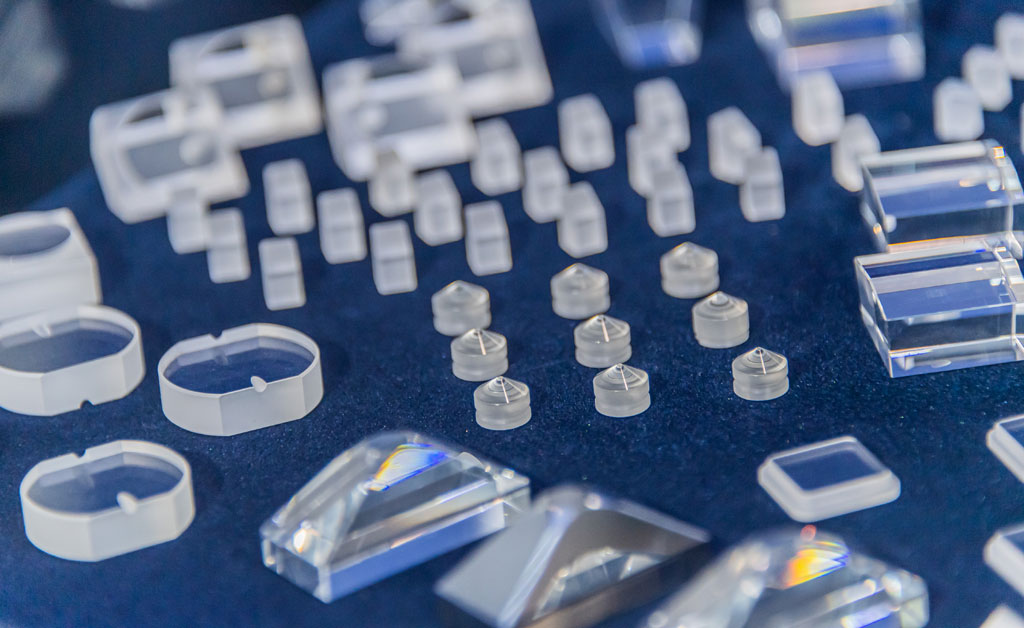
At first glance, optical glass does not look any different from ordinary glass. It is transparent, rigid, and often indistinguishable to the naked eye.
The difference only becomes visible when light passes through it. In precision optical systems, even microscopic variations in composition or internal stress translate directly into measurable wavefront error. These are not defects that can be polished away later—they are built into the material during manufacturing.
Understanding how optical glass is made is therefore not just about process. It is about understanding how optical performance is engineered from the very beginning.
What Makes Optical Glass Manufacturing Different?
Three demands separate optical glass from everything else in the glass industry: refractive-index homogeneity across the full volume of the blank, freedom from bubbles and solid inclusions, and the near-complete elimination of internal stress.
Every subsequent production step exists to satisfy at least one of these three. Miss any of them, and no amount of downstream polishing or coating will recover the performance.
Raw Materials and Batch Preparation
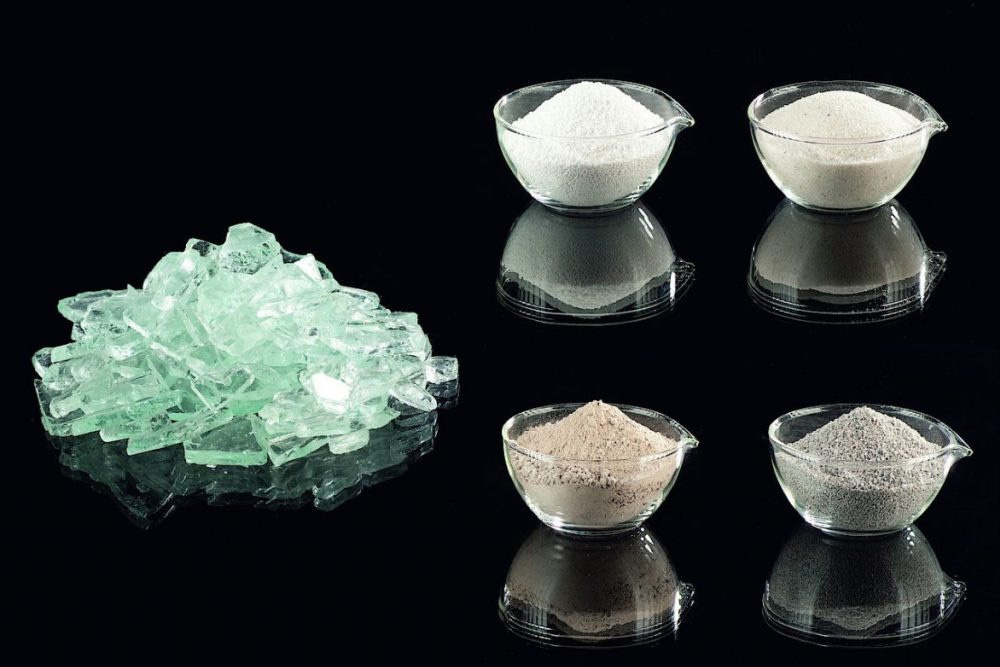
Optical glass starts as a precisely weighed mixture of powdered oxides. The composition determines the optical and physical properties of the finished glass—refractive index, dispersion, transmission range, thermal expansion.
The base former is high-purity silica. Iron is the most common contamination concern: concentrations as low as 10 ppm shift the UV absorption edge and introduce a green tint that makes the glass unsuitable for color-critical work. Raw quartz sand goes through washing, magnetic separation, and grading before it is accepted.
Beyond silica, modifier oxides move the refractive index and dispersion into the target window. Boron oxide lowers dispersion—this is the basis of the BK7 family. Barium oxide and lanthanum oxide raise index without proportionally increasing dispersion, enabling the high-index low-dispersion glasses that apochromatic designs depend on. Lead oxide once dominated the dense flint category but has been largely replaced by titanium and niobium oxides.
Melting and Refining Process
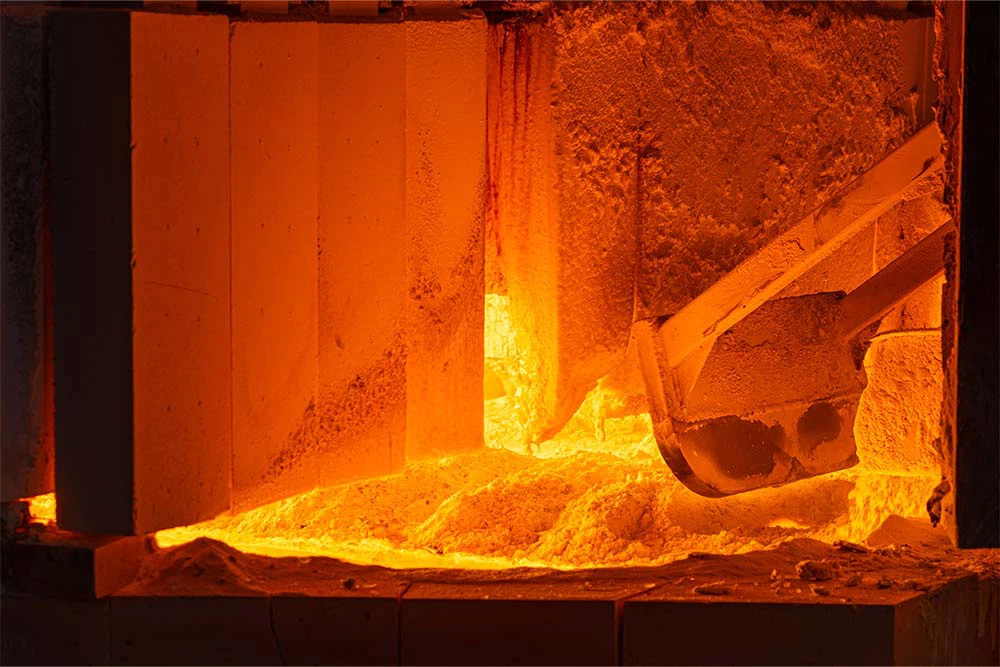
The prepared batch is typically melted in a platinum or platinum–rhodium crucible. These materials are widely used due to their chemical stability and minimal contamination at temperatures above 1,400 °C, where many optical glass compositions become highly reactive.
Initial melting is usually carried out in the range of 1,200 °C to 1,500 °C, depending on composition. During this stage, the batch transitions into a viscous melt containing a significant amount of entrapped gas and partially dissolved raw materials. At this point, the melt is not yet chemically homogeneous and is unsuitable for optical use.
Refining follows, with temperatures increased to approximately 1,450 °C–1,600 °C and held for an extended period. At lower viscosity, gas bubbles can rise and escape from the melt. For larger volumes, refining times may extend to several hours or longer. Some glass compositions incorporate fining agents such as antimony oxide (and historically arsenic oxide), which release oxygen at elevated temperatures and assist in removing smaller bubbles through coalescence.
Mechanical stirring is then applied to improve compositional uniformity. A platinum stirrer is used to reduce refractive-index variations and eliminate striae caused by incomplete mixing. Stirring parameters, including rotation speed and duration, are carefully controlled to balance homogenization efficiency with the risk of introducing additional defects such as air entrainment.
High-grade optical glass may achieve refractive-index homogeneity on the order of Δn ≈ 1 × 10⁻⁵ after sufficient refining and stirring, although this depends on glass type and production conditions.
Following homogenization, the melt is either cooled within the crucible or cast into a preheated mold, depending on the forming process. The material solidifies into a glass blank, which still requires annealing to relieve internal stress.
Annealing: Eliminating Internal Stress
When molten glass solidifies, the outer regions cool faster than the interior, creating a temperature gradient that introduces internal stress. In small optical components, this effect is often limited. In larger blanks—such as telescope optics on the order of hundreds of millimeters—residual stress can lead to measurable birefringence, which may affect polarization-sensitive applications and image quality.
Annealing reduces this stress by reheating the glass to a temperature near its strain point—typically around 500 °C–550 °C for many borosilicate compositions—and holding it long enough for structural relaxation to occur. The glass is then cooled in a controlled manner through the annealing range to minimize the formation of new stress.
Cooling rates depend on glass type, geometry, and thickness. Thin substrates may be annealed within hours to a day, while large optical blanks can require several days to weeks. During cooling, the temperature gradient between the center and surface is carefully controlled—typically within a few degrees—to limit stress development.
After annealing, residual stress is commonly evaluated using polarized light methods. For precision optical applications, stress birefringence is often specified below 10 nm/cm, with tighter requirements (e.g., below 4 nm/cm) applied in laser or polarization-sensitive systems. If stress exceeds specification, re-annealing may be performed, although this depends on production constraints and material considerations.
Why Manufacturing Determines Optical Performance
Refractive-index gradients in the bulk glass cannot be removed by polishing. Scatter from trapped inclusions is not correctable with coatings. Birefringence from incomplete annealing persists regardless of how the element is mounted.
Optical engineers account for this by specifying homogeneity grades, bubble classes, striae grades, and stress limits alongside the glass type—each parameter reflecting a specific aspect of manufacturing control. Two blanks of the same catalog glass, produced by different processes, can perform differently inside the same optical system.